“This Novel Answered Nothing & I Can’t Stop Thinking About It”
While most authors labour to make their opening line unforgettable, Jacqueline Harpman saves her most devastating moment for the final page: “It is strange I am dying from a diseased womb, I who have never had periods and I who have never known men.”
I came to I Who Have Never Known Men after spotting this finale on social media, and I simply had to know more. I read the novel on a quick two-hour flight, driven by a hunger to understand how a woman could find herself at such a cruel, isolated conclusion.
The result is a novel that feels less like science fiction and more like a dissection of humanity’s purpose.
Kitty, Social Media Director

What is it about?
Harpman’s unnamed narrator is the youngest of forty women imprisoned in an underground cage, watched by silent guards who punish any physical intimacy with swift violence. Unlike the older women, she has no memory of a world before captivity. She is referred to only as “the child.”
The others mourn husbands, children, and former lives, but the protagonist mourns nothing — because for her, there is nothing to remember. What struck me most was not the dystopian premise itself, but Harpman’s refusal to explain it. The catastrophe that led to their imprisonment is never addressed; the guards eventually disappear without reason. Freedom arrives suddenly, with a key left in a lock during a moment of panic. Harpman resists spectacle, instead allowing the philosophical consequences of their circumstance to do the heavy lifting.
The others mourn husbands, children, and former lives, but the protagonist mourns nothing—because for her, there is nothing to remember.
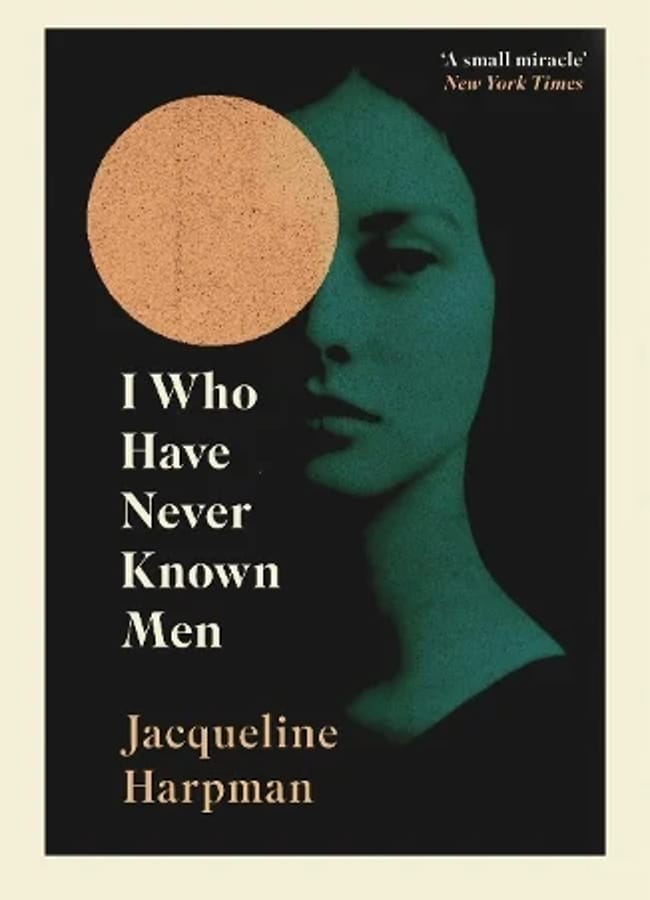
Why you should read it

I Who Have Never Known Men is not a book for those who need every “why” answered or every plot point tied with a bow…
The narrator’s defining trait is her appetite for knowledge. While the other women sink into exhaustion and grief, she insists on learning. Not because knowledge will save her, but because knowing feels like a form of living. In a world stripped of art, music, sex, and history, curiosity becomes the last remaining proof of human nature.
When the women finally escape the bunker, hope is extinguished by the vastness of the empty world. There are supplies and shelter, but no meaning. Harpman suggests that freedom without context can be as imprisoning as a cage. The women remain confined by the haunting knowledge that they will never know what happened to them.
Verdict
Having written science fiction in university, I know how difficult it is to sustain a first-person voice for a character who knows nothing. Even a simple sentence like “I ran up the stairs” can become a logic puzzle when the character has never seen stairs. Yet, Harpman’s voice remains entirely believable and her characters compellingly real.
I Who Have Never Known Men is not a book for those who need every “why” answered or every plot point tied with a bow. It is an easy-to-digest narrative that nonetheless places the reader in the same agonising uncertainty as its characters. If you are looking for a story about what remains of the human spirit when the world ends, this is for you. But don’t go in looking for answers.
Looking for something similar? Read these next


The products on this page have been selected by our editorial team, however, The Handbook may make a small commission on some products purchased through affiliate links.