Chef Judy Joo On Bringing Comforting Korean Cuisine To The World
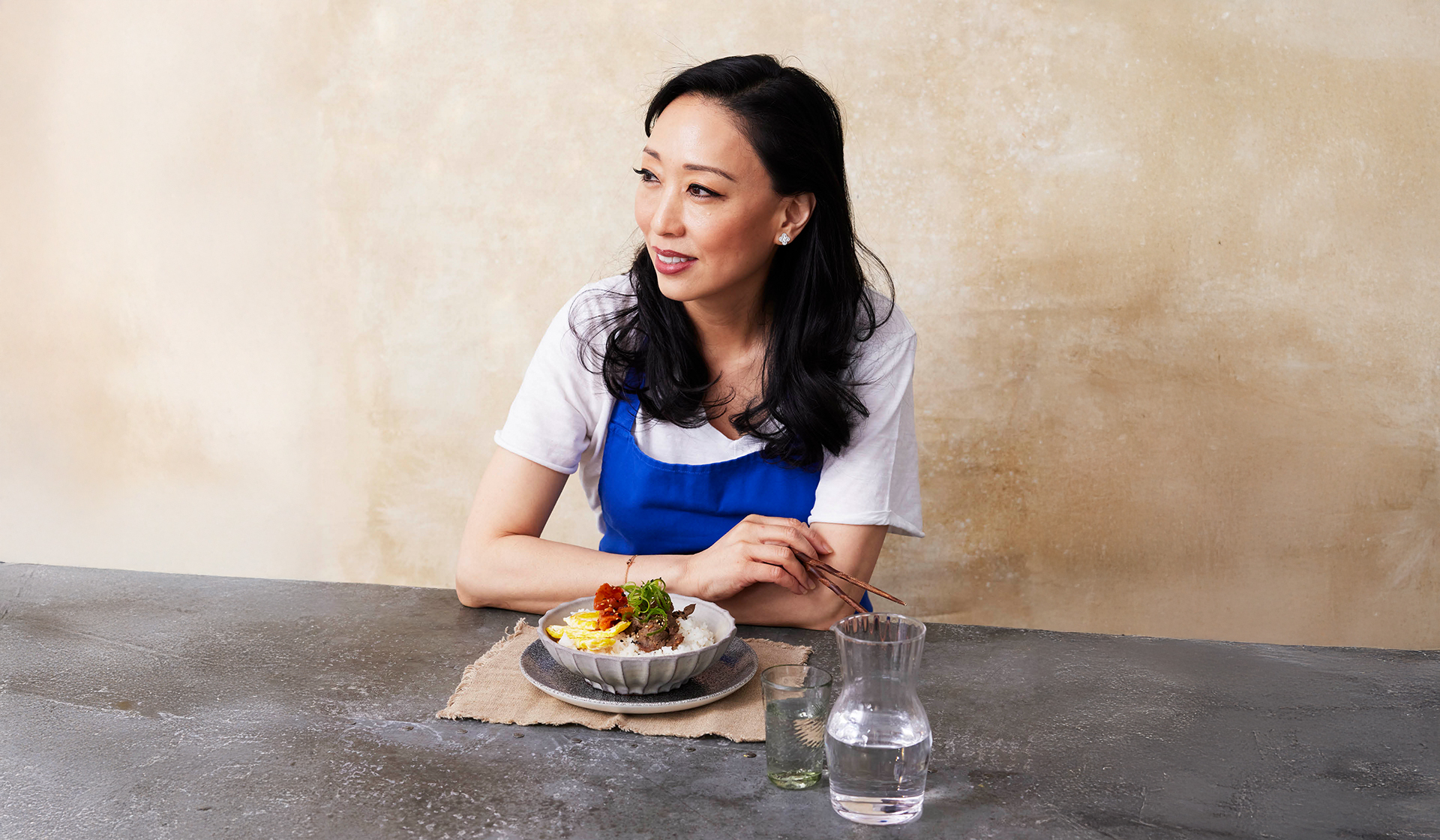
There’s something infinitely comforting about Korean fried chicken. It’s a little sweet and a little spicy; it can be crunchy or sticky; you can slather on sauce and pick it up with your fingers or place it between two buns and make it a burger. It’s fast food with cool kid personality. Or, as Chef Judy Joo, co-founder of Seoul Bird, makers of some of London’s best Korean fried chicken, puts it perfectly – “It’s food that feels like a hug”.
On a Friday morning, we meet at Westfield White City, before the crowds descend at the food court. It is the calm before the storm – the tenders are marinating, the iced tea is brewing, and the tables are shining. Less than forty minutes later, there will be a queue anxiously awaiting their signature chicken burgers or trying to choose between gochujang mayo or sweet garlic soy. And the person we can (gratefully) blame for this queue is seated in front of me.
Judy Joo is a Korean-American chef, restaurateur, TV personality, author and entrepreneur, who is quite simply, the queen of Korean comfort food.
She’s the author of two best-selling cookbooks, Judy Joo’s Korean Soul Food and Korean Food Made Simple and she’s had regular appearances on shows like the Today Show, Wendy Williams, Saturday Kitchen and Cooking With The Stars.
Judy Joo is the queen of Korean comfort food.
She cooks Korean food around the world from the Maldives to Las Vegas, and has competed in some of the world’s most hardcore cooking competitions. (She was the UK’s first female Iron Chef). She also started her career working on Wall Street and never quite imagined she would end up doing this.
From finance to cooking
Joo grew up in New Jersey at a time when there weren’t a lot of Korean ingredients readily available. So her parents would make everything from scratch, from kimchi to dumplings. “There was always something bubbling or fermenting in the backyard,” she says. “My sister and I would get pulled into helping with the dumplings or seaweed – just brushing oil on them and sprinkling salt and roasting them. There was just one little Chinese grocery store, and that didn’t have kimchi, so my mum would have to make do and cook with things they could find.” So while Joo grew up familiar with Korean cooking, she never had her sights set on making a career out of it.
She studied engineering at Columbia University and ended up working on Wall Street, where she worked hundred-hour weeks, battling 6 screens and 40 different phone lines at a time. “You’re screaming all day. You just can’t leave your desk. I was always working, always tethered to my Blackberry (you know, we had Blackberries back then).” She developed sinusitis and laryngitis for nine months straight and just couldn’t get better.
I didn’t get like turned on by making money, I guess, as much as the others.
“You get paid very well, but the soul is left unrewarded, you know, and I didn’t love the markets. I didn’t get like turned on by making money, I guess, as much as the others. Of course, I love money, but you know, I just didn’t find it as soul-satisfying.”
A place in the production line
Joo left her finance job with no real plan; she just knew she wanted to do something in cooking. Joo enrolled at the French Culinary Institute in New York, where she received her Grand Diplome in Pastry, and then got a job at Gordon Ramsay Restaurants.
She started from the bottom of the chain, cutting vegetables, juicing lemons, slicing pineapples for hours, sometimes hardly aware of what dish she was contributing to, but aware that she was part of one little element of it. And while shows like The Bear might not lend the impression that the kitchen is a peaceful place, for Joo, it was infinitely less stressful than working on the trading floor.
“When you have a restaurant, somebody might have a bad meal, or write a bad review, but it can’t lead to the collapse of a bank or something, you know what I mean? The economy could collapse because of rogue traders; it can mean a lot if a decimal point is in the wrong place. But if someone has a bad meal – it’s not the end.”
Other than the fact that she was now working a job where she was on her feet all day, the biggest shift from finance to cooking was the workplace dynamics.
“I’d always worked in places where my opinion counted and mattered. In kitchens, it doesn’t work like that. You’re there solely for production and to mimic and recreate and reproduce the same thing over and over again without changing it at all.”
Food that hugs you back
Joo then moved from the glamour of Michelin kitchens to finding joy in more comforting cuisine. “Believe me, I enjoy a 16-course menu occasionally, but sometimes I just want a piece of fish to be a piece of fish, you know? Not everything has to be transformed into foam or a bubble. Sure, it’s beautiful, but as I’ve gotten older, I’ve figured out that the food that speaks to me more is the kind that hugs me back.”
As I’ve gotten older, I’ve figured out that the food that speaks to me more is the kind that hugs me back.
Joo is at the helm of a fast casual restaurant, but she still believes in trying to pull passion out of people. “It doesn’t matter if the customer journey is four hours or 14 minutes – it still matters. Love what you do, know everything about that fried chicken. That’s what I love to see in my kitchen,” she says.
Connecting the dots backwards
Joo is a familiar face on cooking shows, competitions, and culinary panels. She was awarded the title of ‘Iron Chef UK’ in 2011, becoming the only female Iron Chef in Britain and the second female Iron Chef globally. These days, she’s more likely to be found hosting, judging, or doing live demos than competing. “To pull me out of retirement for a cooking battle, it’d have to be a pretty big cheque,” she jokes.
She’s quick to point out the distinction between cooking and competitive cooking: “It’s not about how well you can cook—it’s about how well you react under pressure and how you can think on your feet. Sometimes they hand you kumquats, M&Ms, and like, an octopus, and you’re expected to make a fine dining dish using hair curling irons.”
I have more stories of failure than I do of success. Failure is part of the process. Embrace it.
It’s chaos by design, but Joo has conquered it and walked away wiser. “I have more stories of failure than I do of success. Failure is part of the process. Embrace it.”
“I didn’t grow up in kitchens,” Judy continues. “But the skill set I bring, from engineering and finance, has made me a better chef and restaurateur.” She has majored in operations research, worked on trading floors, and built a foundation that would later help her approach kitchens with analytical precision. “Setting up restaurants is engineering,” she adds. “Customer journey, design flow, acoustics, materials. It’s all connected. The kitchen is a laboratory.”
Joo’s career has taken her across the globe, from New York to San Francisco, from the snowy peaks of St. Moritz to the sun-drenched islands of the Maldives. “Taking Korean cuisine to the corners of the world is a privilege,” she says. She has held residencies at luxury resorts like Soneva Jani in the Maldives and Soneva Kiri in Thailand, often finding herself prepping meals with dolphins leaping outside the kitchen window. “It’s pretty fabulous. I feel so lucky.”
The next big food trend
Joo has been living in London for the past 20 years, and she’s seen the growth of the city’s dining scene go from being “diabolically bad” to becoming one of the most buzzing foodie destinations in the world. But what are the trends to look out for? “I’m seeing a step away from fine dining – that’s also been influenced by the cost of living crisis. Food is so highly emotive.
When you’re stressed, you don’t necessarily want something that has been plated with tweezers and is a tiny piece of this and that. I want something that hugs me back and makes me feel good, like a recipe that reminds me of my mother, and then that’s almost like your therapy, right?”
Asian foods are also trending highly, the chef says, with the rise of K-pop and Korean dramas, more people are excited about travelling to Asia too. “Younger generations are more excited about spending money on experiences and looking at what people are eating rather than a designer bag someone is carrying.”
Looking the part
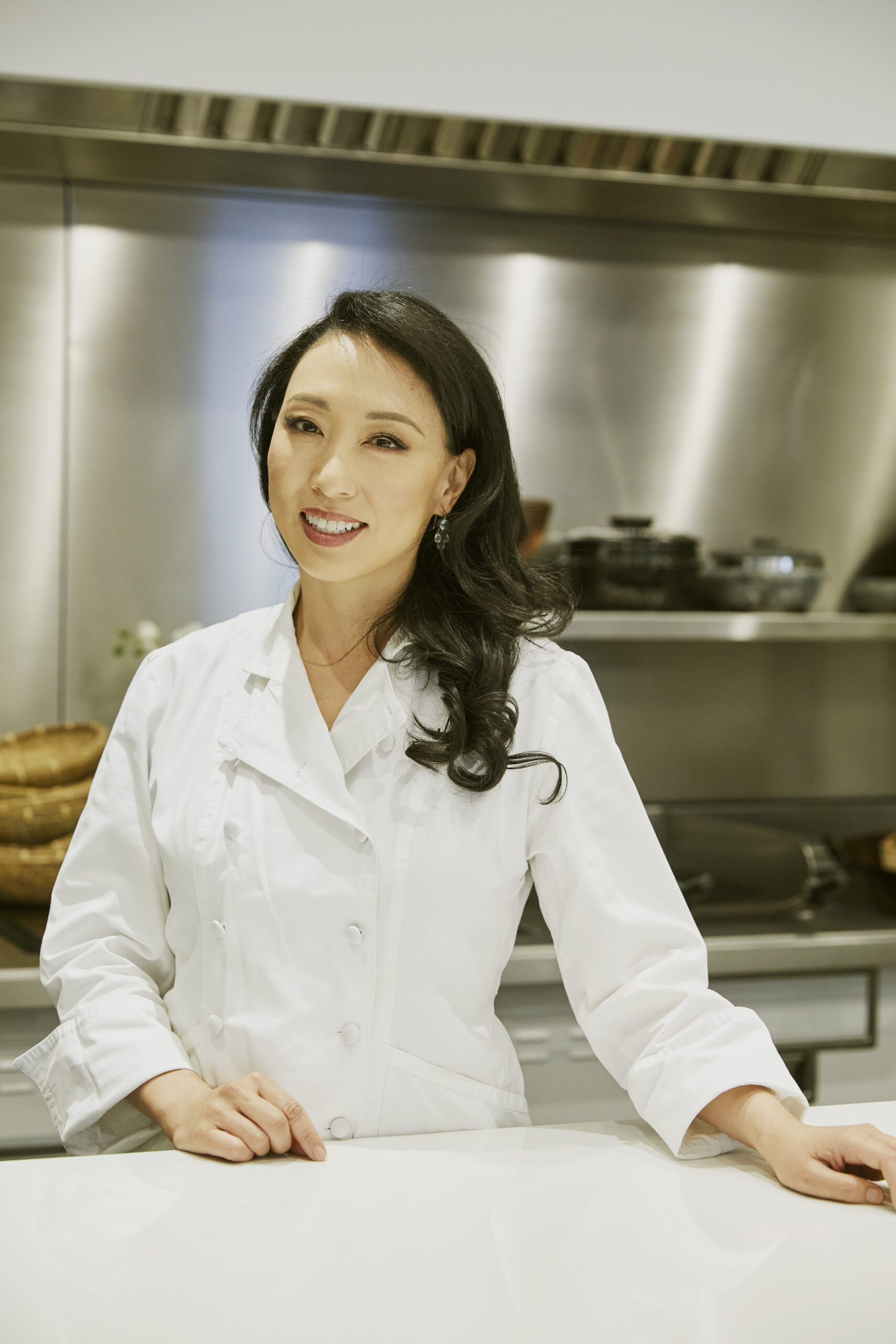
Despite all her success, Joo is frank about the challenges that persist for women in kitchens. “Kitchens are still male-dominated, just look around,” she says. Joo has faced both overt and subtle forms of bias, from being mistaken for a secretary at high-profile events to hearing the phrase, “you don’t look like a chef”, being thrown her way quite often. “Apparently, to be taken seriously, I need to shave my head, get tattooed, and weigh 400 pounds. I refuse to masculinise myself.” Reflecting on her journey, Joo says, “I never imagined this life. Television, books, restaurants in three countries…But I kept pivoting, kept trying. And I never quit.”